Using Shader with Audio Input?
-
Looking to use the audio feature in the linked GLSL shader and really struggling. Can anyone help me understand how to use this shader with Isadora's audio features? I
I've linked the Shader and attached my current patch. The cue I'm working on though is only Q4. Any help would be appreciated
Shader: https://www.shadertoy.com/view...
Device: Omen Laptop running Windows 11
Patch: vinyljournal2.izz -
Shadertoy intakes audio at video textures, and currently Isadora has no way to convert audio to a video texture.
So I converted this shader to use 5 fft inputs as seen below (I am not sure this looks right, since this effect would not run for me on shadertoy).
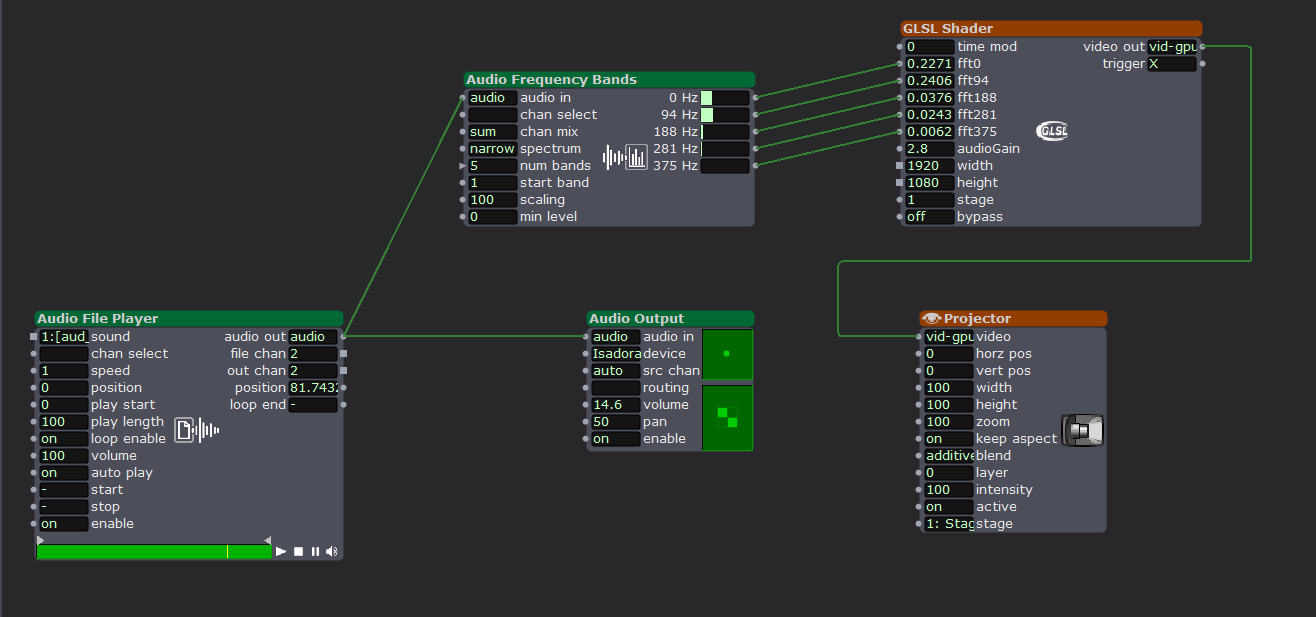
the updated code:
// ------------------------------------------------------------
// Audio-reactive circular visualizer
// Converted from texture-based audio input to 5 numeric bands
//
// Suggested Isadora inputs:
//   fft0   = 0 Hz
//   fft94  = 94 Hz
//   fft188 = 188 Hz
//   fft281 = 281 Hz
//   fft375 = 375 Hz
//
// Expected input range: 0.0 to 1.0
// ------------------------------------------------------------
// If needed for Isadora custom controls, you can adapt these comments
// to the exact syntax expected by the GLSL Shader actor.
//
// ISADORA_FLOAT_PARAM(fft0, f000, 0.0, 1.0, 0.0, "FFT 0 Hz");
// ISADORA_FLOAT_PARAM(fft94, f094, 0.0, 1.0, 0.0, "FFT 94 Hz");
// ISADORA_FLOAT_PARAM(fft188, f188, 0.0, 1.0, 0.0, "FFT 188 Hz");
// ISADORA_FLOAT_PARAM(fft281, f281, 0.0, 1.0, 0.0, "FFT 281 Hz");
// ISADORA_FLOAT_PARAM(fft375, f375, 0.0, 1.0, 0.0, "FFT 375 Hz");
// ISADORA_FLOAT_PARAM(audioGain, gain, 0.0, 3.0, 1.0, "Audio gain");
uniform float fft0;
uniform float fft94;
uniform float fft188;
uniform float fft281;
uniform float fft375;
uniform float audioGain;
// ------------------------------------------------------------
// Utility: sample a pseudo-spectrum from the 5 numeric bands
// ------------------------------------------------------------
float SampleAudioSpectrum(float normPos)
{
    normPos = clamp(normPos, 0.0, 1.0);
    // Apply overall gain and clamp
    float b0 = clamp(fft0   * audioGain, 0.0, 1.0);
    float b1 = clamp(fft94  * audioGain, 0.0, 1.0);
    float b2 = clamp(fft188 * audioGain, 0.0, 1.0);
    float b3 = clamp(fft281 * audioGain, 0.0, 1.0);
    float b4 = clamp(fft375 * audioGain, 0.0, 1.0);
    // 5 points distributed evenly across 0..1:
    // 0.00, 0.25, 0.50, 0.75, 1.00
    if (normPos <= 0.25)
    {
        float t = normPos / 0.25;
        return mix(b0, b1, t);
    }
    else if (normPos <= 0.50)
    {
        float t = (normPos - 0.25) / 0.25;
        return mix(b1, b2, t);
    }
    else if (normPos <= 0.75)
    {
        float t = (normPos - 0.50) / 0.25;
        return mix(b2, b3, t);
    }
    else
    {
        float t = (normPos - 0.75) / 0.25;
        return mix(b3, b4, t);
    }
}
float GetIntensityInRange(float beginNorm, float endNorm, float incrementSize)
{
    if (incrementSize <= 0.0) return 0.0;
    float range = endNorm - beginNorm;
    if (range <= 0.0) return 0.0;
    float result = 0.0;
    float sampleCount = 0.0;
    // Fixed maximum iterations for GLSL compatibility
    for (int i = 0; i < 64; i++)
    {
        float lookupCoord = beginNorm + float(i) * incrementSize;
        if (lookupCoord >= endNorm) break;
        result += SampleAudioSpectrum(lookupCoord) * 2.0;
        sampleCount += 1.0;
    }
    if (sampleCount <= 0.0) return 0.0;
    return result / sampleCount;
}
float GetCornerIntensity(vec2 fragCoord, float checkDist, vec2 corner, float beginSample, float endSample)
{
    float distanceN = 1.0 - (clamp(distance(fragCoord, corner), 0.0, checkDist) / checkDist);
    float intensity = GetIntensityInRange(beginSample, endSample, 0.05);
    float color = distanceN * intensity;
    return color;
}
bool IsWithin(float val, float minVal, float maxVal)
{
    return val >= minVal && val <= maxVal;
}
vec4 innerColour     = vec4(0.0,   168.0, 181.0, 255.0) / 255.0;
vec4 outerRingColour = vec4(119.0, 72.0,  152.0, 255.0) / 255.0;
vec4 highsColour     = vec4(243.0, 174.0, 75.0,  255.0) / 255.0;
vec4 lowsColour      = vec4(222.0, 67.0,  131.0, 255.0) / 255.0;
void mainImage(out vec4 fragColor, in vec2 fragCoord)
{
    fragColor = vec4(0.0, 0.0, 0.0, 1.0);
    // Normalized pixel coordinates (from 0 to 1)
    vec2 uv = fragCoord / iResolution.xy;
    float smallestDimen = min(iResolution.x, iResolution.y);
    vec2 halfDimen = iResolution.xy * 0.5;
    float halfSDimen = smallestDimen * 0.5;
    vec2 centerOffset = fragCoord - halfDimen;
    vec2 nOffset = centerOffset / halfSDimen;
    float fragAngle = atan(centerOffset.y, centerOffset.x);
    float fragAngleDegrees = fragAngle * 180.0 / 3.14159;
    float overAllPulse = GetIntensityInRange(0.0, 0.3, 0.05);
    float pixelDistanceToCenter = distance(fragCoord, halfDimen);
    float idealRingDistance = halfSDimen * 0.8;
    float ringDistance = idealRingDistance + (halfSDimen * overAllPulse * 0.2);
    float pixelRingDist = abs(ringDistance - pixelDistanceToCenter);
    const float ringWidth = 20.0;
    float outerRingIntensity = 1.0 - (pixelRingDist / ringWidth);
    if (IsWithin(outerRingIntensity, 0.0, 1.0))
    {
        outerRingIntensity *= sin(fragAngle * 3.0 + iTime) * 0.5 + 0.5;
        fragColor += outerRingIntensity * outerRingColour;
    }
    // --- Inner ring
    // Start = close to center, End = going further away
    float innerRingEnd = ringDistance - ringWidth * 0.5;
    float lookupAngle = mod(fragAngleDegrees + 180.0, 360.0);
    float pixelLookupIndex = lookupAngle / 360.0;
    float pixelLookupColor = SampleAudioSpectrum(pixelLookupIndex) * 2.0;
    float pulseA = (sin(fragAngle * 3.0 + iTime) * 0.5 + 0.5) * 0.2;
    float pulseB = (cos(fragAngle * 6.0 - iTime * 1.5) * 0.5 + 0.5) * 0.2;
    float pulse = 0.1 + pulseA + pulseB;
    float innerRingStart = innerRingEnd * (1.0 - pixelLookupColor - pulse);
    float innerRingLength = max(innerRingEnd - innerRingStart, 0.0001);
    float innerRingFragProgress = (pixelDistanceToCenter - innerRingStart) / innerRingLength;
    float innerRingIntensity = innerRingFragProgress;
    if (pixelDistanceToCenter < innerRingStart || pixelDistanceToCenter > innerRingEnd)
        innerRingIntensity = 0.0;
    // Inner ring separators
    float angleMod = mod(fragAngleDegrees, 3.0);
    if (IsWithin(angleMod, 0.0, 1.0))
        innerRingIntensity = 0.0;
    fragColor += innerColour * innerRingIntensity;
    // Corners
    float topRightIntensity = GetCornerIntensity(fragCoord, smallestDimen, iResolution.xy, 0.3, 0.65);
    float topLeftIntensity = GetCornerIntensity(fragCoord, smallestDimen, vec2(0.0, iResolution.y), 0.0, 0.25) * 2.0;
    if (topRightIntensity > 0.0)
    {
        fragColor += highsColour * topRightIntensity;
    }
    if (topLeftIntensity > 0.0)
    {
        fragColor += lowsColour * topLeftIntensity;
    }
    // Background spectrum wash:
    // original shader used texture(iChannel1, vec2(uv.x, 0.25)).x
    float texIntensity = SampleAudioSpectrum(uv.x);
    fragColor += lowsColour * texIntensity;
    fragColor.rgb = clamp(fragColor.rgb, 0.0, 1.0);
}