 [ANSWERED] Linking 4-6 projectors
you could add a HDMI switch into the mix before the splitter(s) - these are cheap and readily available - I bought one from a supermarket when I needed to solve the problem of 2 laptops into one projector.
thank you people!
Yes I need to change VJ that is the second part. So I need to have two computers connected:)
 [ANSWERED] Linking 4-6 projectors
I second the HDMI splitter suggestion. There are even 1-to-6 and 1-to-8 HDMI splitters, but the cheapest option would likely be two 1-to-4 HDMI splitters.
[LOGGED] No automatic start for Wave generator
I've logged this as a feature request
 [LOGGED] No automatic start for Wave generator
Thanks a lot but I already know all these solutions. I still think it would be better and more logical if the Wave Generator actor didn't start automatically
[LOGGED] No automatic start for Wave generator
here's a user actor i just made: Go Wave Gen
[ANSWERED] Linking 4-6 projectors
@eva
I remember the pre-HDMI days when projectors ran on VGA, they usually had a VGA out so you could daisychain them together.
[LOGGED] No automatic start for Wave generator
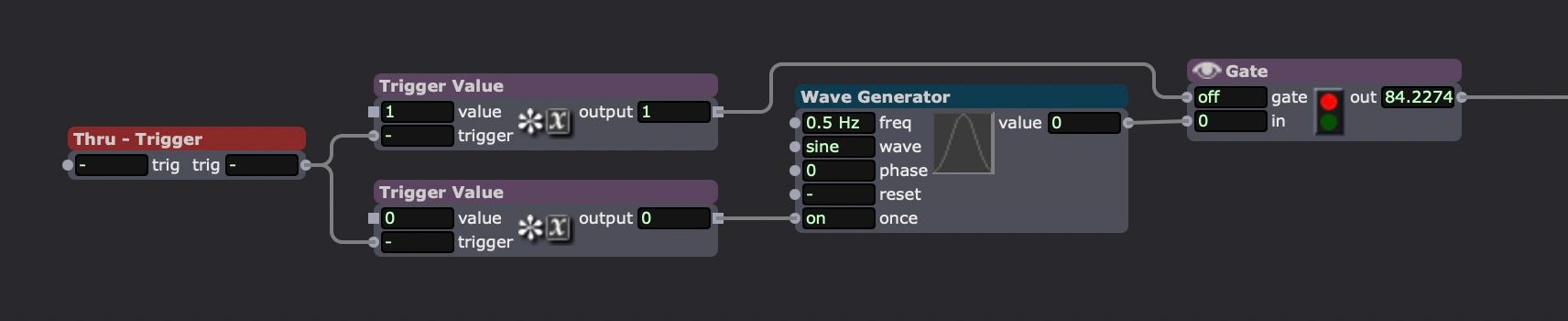
if the time needed to wait before triggering the start of the Wave gen is longer than the duration of the Wave, then you can set it to initialize at 'once' and then mask the output of the first cycle with a Gate:
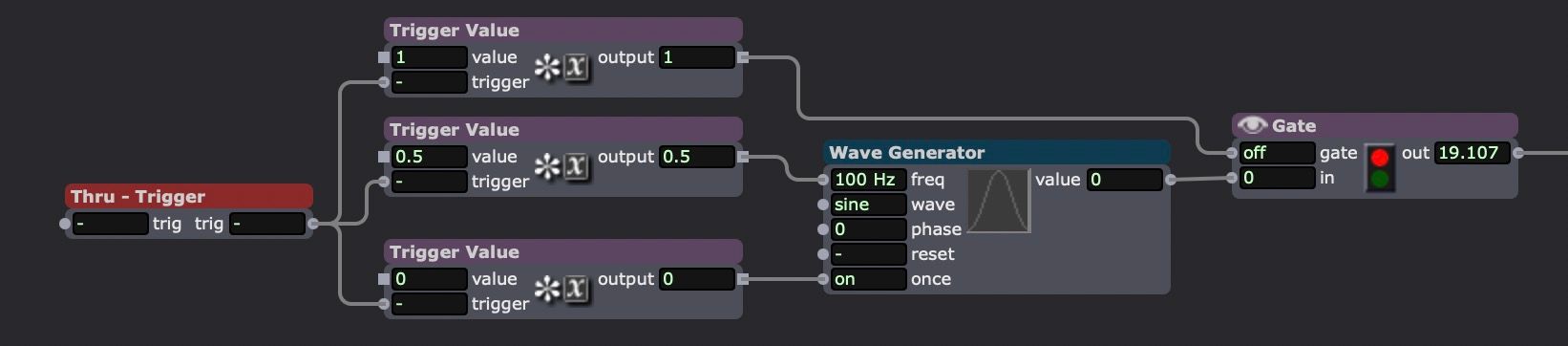
Or you could make it slightly more complex by initializing the Wave Gen to something very short, then sending the actual Frequency when triggering it to start again:
 [LOGGED] No automatic start for Wave generator
The Wave Generator starts automatically when the scene changes. It would be great if the default behaviour wasn’t to start automatically, as this can be achieved using an ‘Enter Scene Trigger’ actor.